

Anthropic Pulls Away, OpenAI Strikes Back, and Google's Gemini Rising

Hey friends 👋 Happy Sunday.
Here’s your weekly dose of AI and insight.
Every Wednesday, Signal Pro members get a step-by-step AI workflow they can apply immediately. No fluff, just practical guides to upskill you and your team. If you’re only reading the Sunday issue, you’re getting half the picture. Upgrade to Pro today.
AI Highlights
My top-3 picks of AI news this week.

Anthropic
1. Anthropic Pulls Away
Anthropic disclosed Q1 2026 revenue grew 80x year-on-year, with annualised run rate now estimated at over $44B, committed $200M to a four-year Gates Foundation partnership across global health and education, and overtook OpenAI in verified business customers for the first time.
Revenue trajectory: Dario Amodei told Anthropic’s Code with Claude developer conference the company planned for 10x growth this year but saw 80x annualised, with customers spending $1M+ annually climbing from a dozen two years ago to over 1,000 today (doubled in under two months), against funding talks of $30B reportedly approaching a ~$900B valuation.
Philanthropic deployment: A four-year Gates Foundation partnership directs $200M in grants, Claude credits, and technical support toward polio, HPV, and preeclampsia vaccine candidates plus African language accessibility, spanning global health, life sciences, education, agriculture, and economic mobility.
Enterprise crossover: Ramp’s May AI Index put Anthropic at 34.4% of business customers versus OpenAI’s 32.3% (up from 9% in May 2025), and PwC formally expanded its alliance to certify 30,000 staff on Claude with a global rollout targeting its 364,000-person workforce.
Alex’s take: Anthropic also published a paper this week setting out four fronts of AI competition: intelligence, domestic adoption, global distribution, and resilience. The Gates Foundation deal puts American AI infrastructure into emerging markets, ahead of the cheap Huawei/Alibaba stack the paper itself warns about. Markets are now pricing Anthropic as strategic infrastructure, especially ahead of what will likely be a blockbuster IPO. Back in February, Anthropic was winning the coding war organically while OpenAI bought Windsurf. That playbook has now expanded from coding to enterprise default. The lead is widening on every front all at once.
OpenAI
2. OpenAI Strikes Back
OpenAI interestingly followed suit on two of Anthropic’s biggest enterprise plays from earlier this month, moving into deployment services and cybersecurity inside a single week. At the same time, the company kept consumer momentum going inside ChatGPT with new mobile and personal finance capabilities.
Deployment Company: The new venture launched with $4 billion from 19 investment, consulting, and integration firms, led by TPG with Bain Capital, McKinsey, Capgemini, and Goldman Sachs among the backers. OpenAI also acquired UK consulting firm Tomoro for its 150 Forward Deployed Engineers, mirroring Anthropic’s $1.5 billion venture with Blackstone, Hellman & Friedman, and Goldman Sachs.
Daybreak cybersecurity: A new cyber-defensive initiative built on GPT-5.5-Cyber and Codex Security, with eight major security vendors, including Cloudflare, CrowdStrike, and Palo Alto Networks, integrating under OpenAI’s “Trusted Access for Cyber” programme. The direct counterpart to Anthropic’s Project Glasswing and Claude Mythos.
ChatGPT product velocity: Codex now runs inside the ChatGPT mobile app, letting users kick off coding agents from their phone and approve next steps while the work continues on a connected laptop (akin to Claude Dispatch). OpenAI also rolled out a personal finance experience inside ChatGPT Pro, connecting US users’ financial accounts from over 12,000 institutions via Plaid so ChatGPT can answer questions grounded in real spending, balances, and investments.
Alex’s take: Bain, McKinsey, and Capgemini are now investors in OpenAI's deployment company, the venture designed to compress their own AI consulting practices. Every major consulting firm has formally agreed that frontier AI deployment is the most defensible product they have left. Forward-deployed engineering has historically been a relationship-bound skill that doesn't scale like normal headcount, and OpenAI now needs to grow that capability, coming up head to head agaisnt Anthropic’s competing initiative (see the Idea I Learned for more).
3. Google’s Gemini Rising
Most companies go quiet in the lead-up to a major keynote. Google did the opposite. The days leading up to Google I/O 2026 brought a flurry of updates from across the Google ecosystem.
Gemini Intelligence: An agentic AI layer running underneath Android itself, handling multistep tasks across apps without switching. Demos: photograph an event flyer and it finds the event on Expedia; turn a grocery list in your notes app into a cart in your preferred shopping app. Rolling out to the latest Pixel and Samsung Galaxy phones this summer, with the new Googlebook laptops and Aluminium OS both launching it on desktop later this year.
Magic Pointer: Google DeepMind’s reimagining of the 50-year-old mouse pointer. Users direct Gemini through motion, speech, and natural shorthand. Hover, wiggle, or speak to surface contextual suggestions tied to whatever’s on screen. Currently experimental and demoed on Googlebook.
Isomorphic Labs: Demis Hassabis’s DeepMind spinout closed a $2.1B Series B led by Thrive Capital, with new backers Abu Dhabi’s MGX, Singapore’s Temasek, and the UK Sovereign AI Fund. BioSpace called it the second-largest biotech round in history, behind Altos Labs’ $3B in 2022. Pharma partnerships with Lilly, Novartis, and Johnson & Johnson back the platform with billions in milestone-tied money.
Alex’s take: Apple has owned phone-laptop continuity for over a decade. Google is finally closing the gap by inverting the stack with Gemini Intelligence becoming the primary interface: the Googlebook is the peripheral, and Magic Pointer turns the cursor into an interpreter of intent. Over the next decade we’re going to see a very real shift in how we direct computers. I’m especially excited about the emergence of Isomorphic Labs and their mission to “solve all disease”. I wonder how long it will take for a compound designed by them to reach a human body. That will be the truest test of them all.
Content I Enjoyed
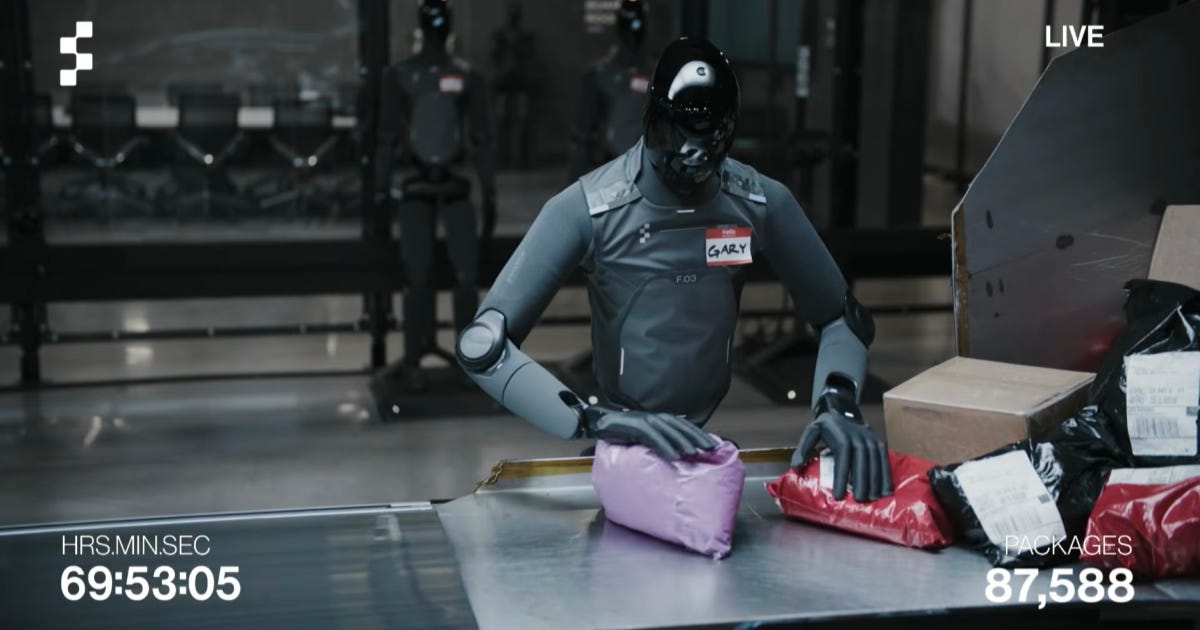
Figure’s humanoids worked an 8-hour shift
Figure AI’s livestream of their F.03 humanoid robots running a fully autonomous package-sorting operation hit over 13 million impressions on X this week. The robots run on Helix-02, Figure’s vision-language-action model, processing everything onboard with no teleoperation. What started as an eight-hour demonstration has now crossed 100,000 packages, still running, with the robots going until failure.
It was fascinating to watch the flurry of initial pushback online, with people claiming that the robots were being remotely controlled from elsewhere via teleoperation. Over 90 hours in, and that same pushback has gone awfully quiet. F.03 is picking packages at roughly the three-second cadence a human hits, with multi-robot coordination all handled visually. If one robot was low on battery or detected a fault, it walked itself to maintenance and called a replacement from the fleet.
For this specific task, I’d argue that purpose-built parcel sorters move faster, cost less, and don’t need battery breaks. But the wider bet here surrounds generalisation. The packages on the belt are cardboard rectangles or soft packets of roughly similar size, while real warehouse floors handle bags, buckets, and items weighing one to fifty pounds. When a humanoid can do them all, like a human worker, that’s when the human form for robotics really takes off.
Idea I Learned
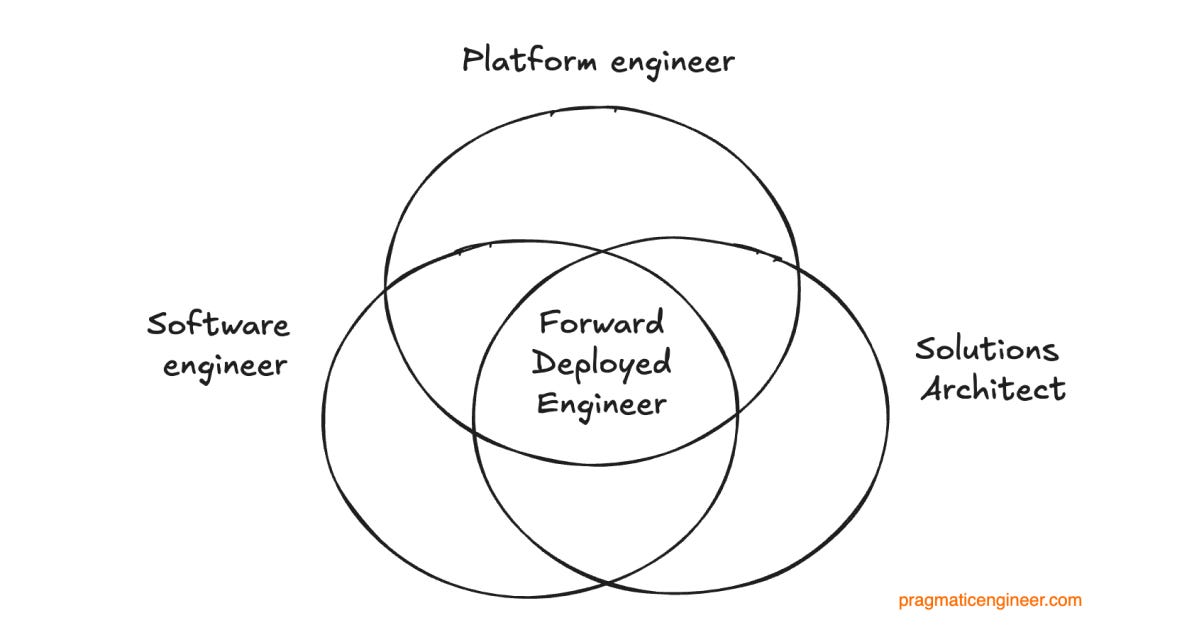
Every AI lab is becoming Palantir
On 4 May, Anthropic announced a $1.5 billion venture with Blackstone, Hellman & Friedman, and Goldman Sachs to embed engineers inside mid-market companies. On 11 May, OpenAI launched the OpenAI Deployment Company with $4 billion from 19 backers including TPG, Bain, McKinsey, and Capgemini, and acquired London consultancy Tomoro to bring 150 Forward Deployed Engineers in on day one. On 12 May, The Information reported Google is hiring hundreds of FDEs of its own.
It seems as though every AI lab has looked itself in the mirror and decided it wants to be Palantir. Palantir invented the FDE role. Engineers fly to the customer, sit with operators, learn the workflow, ship code that wraps a model around the actual problem, and stay until production works. Until 2016, Palantir had more FDEs than software engineers.
FDEs are about to become one of the most in-demand jobs in tech, and the reasoning behind this is structural change. Firstly, models commoditise very quickly. Getting one into production without breaking everything is the hard part, and agents make it harder still, given non-deterministic outputs, messy data, evaluation criteria that need constant tuning, and workflows that have to be redesigned around the model.
Secondly, for every dollar companies spend on software, they spend six on services. That ratio built Accenture, Deloitte, and IBM Global Services into a multitrillion-dollar industry. The labs are now positioning to take that revenue themselves, with implementation handled by their own engineers rather than slide-producing consultants. Vendors who used to chase 15% of a department’s budget at high margins now see a path to 90% of it, even at lower ones.
The deployment layer is the new moat. The engineers who can sit inside a Fortune 500 customer’s office and ship working agents are about to become the most valuable hires of the decade.
Quote to Share
SpaceX’s new place in the AI stack:


Google is in advanced talks with SpaceX to launch Project Suncatcher, its plan to put TPUs into low Earth orbit by early 2027.
The Suncatcher news came a week after Anthropic agreed to take the full 300 megawatts of Colossus 1 in Memphis, and a month after SpaceX secured an option to buy Cursor for $60 billion. In 2024 you would have struggled to put any two of these companies on the same partnership chart, let alone all four. They now share a common supplier, and that supplier is a launch business called SpaceX. Interestingly, Google owns 6.1% of SpaceX and has a Google executive, Don Harrison, on its board.
The reason SpaceX keeps showing up in these announcements is that it sits atop the constraint everyone else is fighting. AI compute is outgrowing the grid faster than substations can be built, and the cheapest path to more power increasingly runs through sun-synchronous orbit, where solar panels operate roughly 8x more efficiently than on the ground. SpaceX has the launch cadence, the satellite network, and the operational track record to make orbital compute feasible this decade, and anyone serious about scaling next-generation models has to rent some of that infrastructure.
Source: @lochan_twt on X
Question to Ponder
“What’s the real bottleneck in the AI race right now?”
Chips, models, and talent were the bottlenecks of 2023 and 2024.
The constraint has now moved from chip limitations and capital limitations to power limitations. Hyperscalers and neoclouds are competing for grid capacity, substation access, and entire power plants, and what’s more, building new generation runs years longer than shipping new GPUs. Transformer lead times have stretched from 24-30 months pre-2020 to as long as 5 years today.
The best way to compare AI infrastructure companies today is by dollar per watt of contracted capacity. Nebius around $15 per watt, CoreWeave around $16, IREN around $3.80, Hut 8 around $1.18. Utilisation, contract quality, and chip vintage sit beneath this, so $/watt is the input against which everything else compounds.
Each shift in the AI race rewards a different kind of company, and it’s clear we’re moving to its lowest layer: energy. Next week’s Google I/O announcements, the OpenAI Deployment Company push, and Anthropic’s moves all depend on this layer of the stack holding up.
Already a subscriber? Get your whole team on board. Signal Pro group subscriptions give everyone access to weekly AI workflows and tutorials, practical upskilling that pays for itself. It’s the kind of thing L&D budgets were made for. Share this with your manager today.
💡 If you enjoyed this issue, share it with a friend.
See you next week,
Alex BanksP.S. Unitree unvelieved GD01, a manned transformable mecha.
great read. the update on openai and their response to me is fascinating. really makes me wonder what’s next.
As always, excellent insight and information thank you🏠🏚️🏡🏘️🍀✔️