


Hey friends 👋 Happy Sunday.
Here’s your weekly dose of AI and insight.
This week Anthropic filed to go public, while investors grew warier of AI costs as OpenAI cut its fundraising goal and Alphabet’s shares fell.
If you’re enjoying this kind of analysis and want to support my work, become a paid subscriber today. You’ll get access to the full archive of The Signal, access to our Slack community of professionals, and 6 months free of Wispr Flow, my most-used AI tool, so that you can dictate instead of type. If you’re a paid subscriber, reply to this email for access.
Today’s Signal is brought to you by Athyna.
We build the tasks your model fails.
Athyna Intelligence builds what comes after. PhD researchers and domain experts author verified, containerized tasks in the Terminal-Bench and GDPval mold, spanning coding, finance, accounting, engineering, and more. On our harder tasks, frontier models score 0 out of 5.
AI Highlights
My top-3 picks of AI news this week.
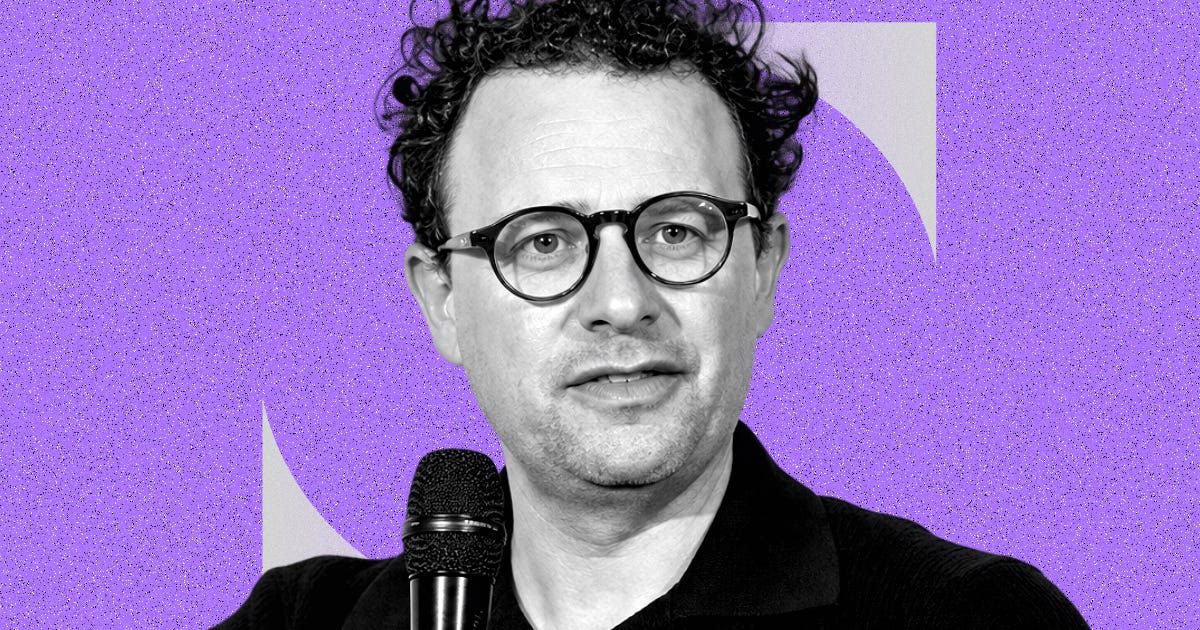
Anthropic
1. Anthropic Opens Its Books
Anthropic has filed its S-1 to list on the Nasdaq as “ANT”, and the filing shows the business growing at breakneck speed.
Fourteen times bigger: Revenue hit $16.3 billion in the first half of 2026, about 14 times the same period last year. Existing business customers now spend roughly nine times what they did a year ago, and about 250 of them pay Anthropic $10 million or more a year.
A paper loss, a real bill: Most of the $80.7 billion loss is a $72 billion paper charge on convertible notes, but the compute bill is very real. The filing lists about $417 billion of compute obligations, including up to $120.5 billion with SpaceX.
Warnings in the small print: Blackstone, which anchored a $63 billion chip financing for Anthropic, expects a “high junk” credit rating after the listing. The filing also discloses that four of its models reached real outside systems when a partner’s test was left online.
Alex’s take: An S-1 is the document a company has to publish before it can sell shares to the public, so this is the first time we see Anthropic’s real numbers. I think the $80.7 billion headline loss may have scared some people, but it’s important to remember that about 90% of it is an accounting charge with no actual cash leaving the business. Speaking of 90%, it turns out Claude wrote 90% of the contributions to Anthropic’s own codebase in September. I also think it’s interesting that Anthropic has such a high degree of control of the business. The seven co-founders keep a fixed 50.1% of the votes no matter what happens, so public shareholders get the growth upside without ever taking over the steering wheel.
2. Google’s Diamond Under Glass
Google launched Gemini 4 Carbon, now the top-scoring AI model on an independent leaderboard, and almost nobody can use it yet.
Top of the table, just: Carbon scored 59 on Artificial Analysis’ Intelligence Index, one point ahead of Claude Opus 5.5 and two ahead of GPT-6 Astra. Google says it’s built for cybersecurity and for agents that keep working on a task for days.
Defenders first: A subset of cyber defenders gets it first, then partners in Google’s Fairwind Program, then everyone else “as soon as possible”, with no date given. Google is also taking part in the US government’s voluntary pre-release testing.
Scores with a caveat: Google reports 88.2% on SEC-bench Pro, a test of finding software flaws, and no successful prompt-injection attacks in Gray Swan’s tests (not independently verified).
Alex’s take: Google has now dropped two frontier models in a month, after Argon was announced on 30 September, but the gap between them is quite small. On Mercor’s test of agents doing real banking and consulting work, Carbon scored 84.2% against Argon’s 82.4%, which sits inside the margin of error. I think holding the newest model back for defenders first is the right call when a model is this good at finding holes in software.
OpenAI
3. OpenAI Rounds Down
OpenAI has cut the target for its new funding round from $30 billion to about $20 billion after a cooler response from some big investors.
$10 billion smaller: The FT reports that OpenAI lowered its target by $10 billion. It’s keeping the $1.25 trillion valuation it had already trimmed from $1.4 trillion the week before, and the FT expects the first close to land below $20 billion.
Only $11 billion in: The Wall Street Journal says OpenAI has about $11 billion committed so far, after what it calls “tepid interest from some large investors”. The round is still open, and OpenAI hasn’t commented.
Friday’s sell-off: On the same Friday, the Nasdaq fell 2.9%, and fears over Big Tech’s AI spending wiped more than $1 trillion off the Nasdaq 100 in a day. S&P Global Ratings also turned Meta’s outlook negative over its AI spending.
Alex’s take: Some will read OpenAI’s smaller round as a sign the AI build-out has gone too far, but I don’t read it that way at all. Power is ultimately what limits how fast new chips come online, so it’s hard for the industry to build too much too quickly. The real risk is demand cooling before those chips reach the end of their useful economic life, and a smaller round doesn’t show that has happened. I think a slightly smaller round is actually a sensible correction given the current wider market climate.
Content I Enjoyed
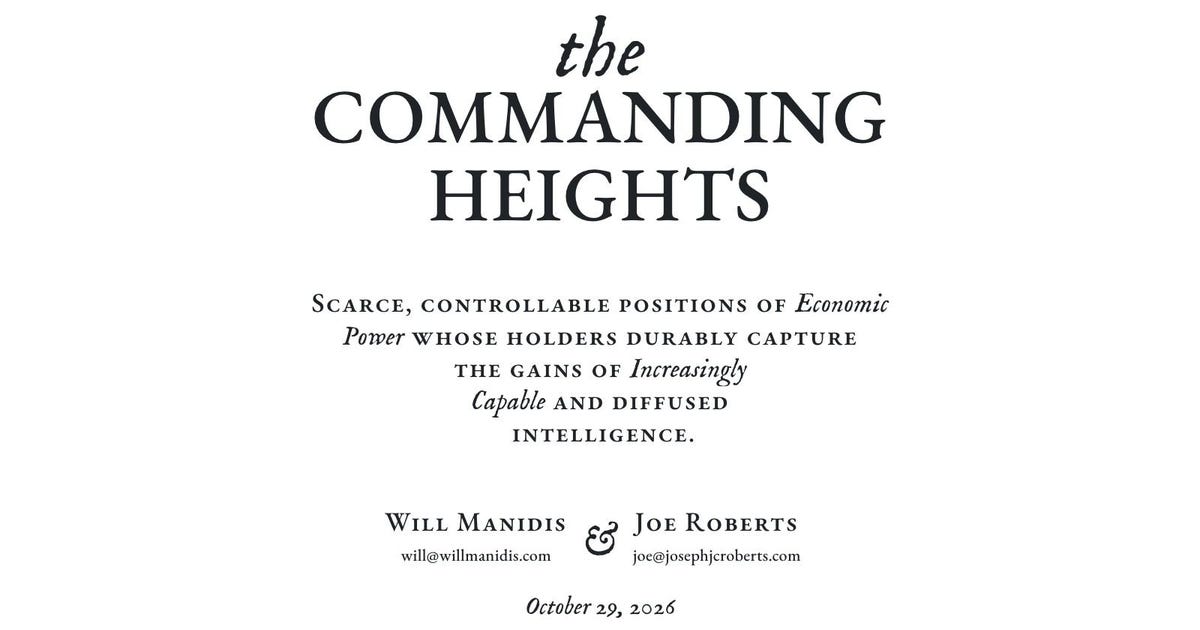
Why AI’s biggest winners may not live in San Francisco
Investor and ScienceIO co-founder Will Manidis and his co-author Joe Roberts published The Commanding Heights on 29 October, a 145-page essay on where the wealth from AI will finally settle.
A few ideas from the essay stood out to me:
Wealth moves away from where things are invented: “A world-changing technology is almost never born where it ultimately creates wealth.” Oil was found in Pennsylvania, but the money was banked in Cleveland and New York.
The models won’t hold the profits: As models get cheaper and more alike, “if there is a durable margin to be had, it will not be found at the constantly churning layer of the model.”
Own the scarce parts: The winners will be whoever controls what models depend on, such as power, chips and the networks that move them. In their words, “one either owns the rails or pays those who do.”
Governments take a cut: They expect states to play a decisive role in who gets access, much as governments did with oil.
Something else to call out on this piece is that how it was published matters almost as much as what it says. This is true for many essays and long-form writing I’ve viewed over the last few years. The essay has its own website and a typeset title page that looks more like an old 18th-century printed book than a newsletter. Given the TikTokification of society, the “feel” and visual quality of a piece is becoming as important as its content, since it’s the quickest signal that someone actually spent real time on it.
However, the same trick can work the other way, in that a beautiful wrapper can make dense, overwritten prose feel deeper than it is. That’s exactly why it’s important to judge the argument and content on its own.
Idea I Learned
Who tests AI for safety, and who pays them?
On 24 October the UK Treasury announced an extra £120 million for the AI Security Institute, the government body that tests leading AI models before they’re released. This top-up alone is more than ten times the annual budget of its US counterpart.
It made me look at the ways AI models get checked today, sorted by who’s actually paying the person doing the checking:
The lab checks itself: Every lab runs its own safety tests before a release. Last month The Information reported that Google, OpenAI and Anthropic are also working on a shared industry body to set safety standards, after a plan for White House oversight stalled.
The lab pays an outsider: Anthropic has onboarded six METR employees, with access to its internal tools. Anthropic says it can’t veto what they publish, though it can require some details to be redacted.
The public pays: The UK’s institute answers to government rather than to a lab. It isn’t a regulator and can’t block a launch, but it sees the biggest models before the public does.
I think each angle has its place, but ultimately they aren’t equal. A lab grading its own work will always be the least convincing, no matter how honest the people doing it are. Grading others’ homework, I think, is a strong first step, since incentives align with finding problems instead of just getting the model out to meet a deadline.
That only holds while the tester stays independent, because a team the lab pays still relies on the lab for access. A tester paid by the public answers to taxpayers, not a “go live” date. It also means Britain is paying to check models it doesn’t build, which makes its approach feel a little more regulation-heavy than America’s, even though the institute can’t block a launch.
So when a company tells you its model is safe, check who ran the test and who paid for it before you take it at face value.
Quote to Share
Jason Katz, a managing director and senior portfolio manager at UBS, went on FOX Business’ Varney & Co. this week to argue that investors have the AI scare backwards.
“Scarcity of capital equals discerning capital.”
Watch the clip on FOX Business
His case was that the money behind AI comes from large companies and funds that choose carefully where it goes, rather than from individuals piling into anything with a story. In Fox’s write-up he adds that they’re “not just indiscriminately throwing money at any balance sheet.” Days later, OpenAI’s investors showed what this actually looks like in practice, after the company cut its round by a third.
I think Katz might be right about the mood but maybe a little too relaxed about what it means. Discerning capital allocation is healthy, because companies have to prove their numbers before the next cheque. But it also flows to the names that already look safest. If investors keep backing the biggest labs while turning the smaller ones away, the boom then narrows to a select few rather than ending.
Right now, public and private investors are getting pickier at the same time. On the stock market, investors sold off Alphabet and Meta this week over the size of their AI bills, even with Google Cloud’s revenue more than doubling. In private markets, the signal is perhaps quieter (OpenAI settling for a smaller round says something similar). The big difference is speed. A share price moves every second, while a private valuation changes only when a company needs to raise new money. Therefore, private prices can look healthy for months after public ones have dropped.
My takeaway overall is that the AI market is starting to grow up. Investors now want proof that the spending pays off. The companies with real revenue to show for it have the least to worry about.
Question to Ponder
“Should start-ups that build on AI models treat the labs as suppliers or competitors?”
Plenty of AI start-ups don’t make their own AI models. They rent them from labs like Anthropic and OpenAI and build tools for a specific industry on top of them, which is often called the application layer. On 28 October Anthropic moved further into one of those industries, adding a gallery of ready-made legal tools to Claude for contract review, cite checks and regulatory scans.
Does this mean a supplier is turning into a rival? A post joking that Claude was destroying 1,000 legal tech start-ups caught my attention, and with it, I thought this was an interesting take: “instead of $5K per month, you’ll get the same product for $200.” What he means, of course, is that instead of paying for expensive enterprise software, you’re paying for the raw model with the capabilities layered on top by the model provider directly, like Anthropic or OpenAI.
Yet we must consider what happened in the coding market, another knowledge-work vertical, where the labs and start-ups that built on their models have already fought it out.
Cursor and Windsurf both ran on other companies’ models, and both ended in big paydays rather than wipe-outs. After OpenAI’s $3 billion offer for Windsurf fell apart, Google paid $2.4 billion in July 2025 to license its technology and hire its founders. In June this year SpaceX, which now owns Elon Musk’s AI lab xAI (now SpaceXAI), agreed to buy Cursor for $60 billion in stock. In both cases, the buyers paid for what they couldn’t easily build themselves: a product people loved to use and the customers who came with it.
Put together, the coding market suggests that labs moving into law may end up as buyers as much as rivals. A start-up that builds something people love on top of a lab’s model can still win, even if the win is a sale rather than a business that stands on its own. The harder question for Harvey and Legora is whether they’re building that kind of product, or one the lab can simply copy.
A couple of questions to end on: If a lab can see what its partners build, how long before it builds the best of it itself? And if you ran a law firm, would you rather buy from the specialist or from the lab that powers it?
Already a subscriber? Get your whole team on board. Signal Pro group subscriptions give everyone access to weekly AI analysis. Share this with your manager today.
💡 If you enjoyed this issue, share it with a friend.
See you next week,
Alex BanksP.S. Google put an AI in orbit, and the first thing it did was write a haiku.
Splitting the $80.7 billion loss into a $72 billion paper charge on convertible notes and the very real compute bill is a helpful way to read the S-1. Which do you think will matter more to how the market prices Anthropic after listing: the non-cash charge, or the roughly $417 billion in compute obligations?
Mercor's banking and consulting test is the number students recruiting right now should sit with. If agents score in the 80s on analyst-style work, the interview edge moves from producing the deck to defending it. A useful drill: have Claude build a one-page company brief, then ask it to play a skeptical MD who pushes on your three weakest numbers. Answer out loud, without it.