


Hey friends 👋 Happy Sunday.
Next week, I’m sharing the first workflow issue exclusively for paid subscribers. Insider recommendations on AI tools I’ve spent 100+ hours testing to help you stay on the bleeding edge. I can’t wait to share it with you.
AI Highlights
My top-3 picks of AI news this week.

Runway
1. Runway Races to the Top
Runway released Gen-4.5, now the world’s highest-rated AI video model with a 1,247 ELO score on the Artificial Analysis benchmark, surpassing Google’s Veo 3, Kling 2.5, and OpenAI’s Sora 2 Pro.
Benchmark dominance: Gen-4.5 scored 1,247 ELO points, beating second-place Google Veo 3 by 21 points and OpenAI’s Sora 2 Pro by 41 points, establishing clear technical superiority in motion quality, prompt adherence, and visual fidelity.
Physical precision: Achieves unprecedented physical accuracy with realistic weight, momentum, and force dynamics, handling complex multi-element scenes, intricate camera choreography, and diverse aesthetics from photorealistic to stylised animation at Gen-4 speed and pricing.
Known limitations: The model still struggles with causal reasoning (effects preceding causes), object permanence (disappearing objects), and success bias (actions succeeding unrealistically), issues Runway identifies as critical for advancing world modelling capabilities.
Alex’s take: Two years ago, Runway released Gen-1, the first publicly available video generation model. Now they’re setting a new benchmark. The 41-point gap over Sora 2 Pro is particularly significant given OpenAI’s resources and market position. I do like Runway’s explicit focus on world modelling here—instead of just building video generators, they’re building systems that understand physical reality. We’re moving closer and closer towards foundation models that can simulate real-world physics and consequences.
2. Google’s Gemini Blitz
Google launched three major Gemini-powered products this week: advanced reasoning with Deep Think, no-code workplace automation through Workspace Studio, and AI Mode as the default search experience.
Reasoning powerhouse: Gemini 3 Deep Think mode is now available to Ultra subscribers, achieving 41.0% on Humanity’s Last Exam and an unprecedented 45.1% on ARC-AGI-2 through parallel reasoning that explores multiple hypotheses simultaneously.
Automation for everyone: Workspace Studio enables anyone to build custom AI agents in minutes without coding, automating everything from meeting summaries to email drafts to complex multi-step workflows across Gmail, Chat, and Drive.
Search reimagined: AI Mode is now the default search experience, delivering AI Overviews upfront with conversational follow-ups built in—eliminating the need to switch between traditional search and AI Mode while fundamentally changing how users interact with information.
Alex’s take: Google went absolutely nuclear with product velocity this week, and I genuinely feel for OpenAI. Workspace Studio feels like it can now eliminate entire categories of low-leverage headcount. That ops person who manually triaged feedback, updated spreadsheets, and nudged stakeholders? Gone. Replaced by a $0 marginal cost agent that never sleeps. The long tail of grunt work that justified whole strata of roles is getting consumed by tiny models, triggers, and glue code. This completely reshapes how companies staff operations.
ByteDance
3. ByteDance Beats the Benchmark
ByteDance released Vidi2, a multimodal video model that substantially outperforms GPT-5 and Gemini 3 Pro on video understanding benchmarks, combining temporal retrieval, spatio-temporal grounding, and video QA in a single system.
Benchmark dominance: Vidi2 beat GPT-5 and Gemini 3 Pro across VUE-TR-V2 and VUE-STG benchmarks, scoring 60.3% versus GPT-5’s 33.6% on spatio-temporal grounding and 59.1% versus 41.1% on ultra-short video retrieval.
Comprehensive capabilities: Handles videos from 10 seconds to 30 minutes with three core functions—finding specific moments via timestamps, tracking objects across frames with bounding boxes, and answering questions about video content.
Production workflows: Enables automated multi-view switching, composition-aware cropping, plot understanding, and character tracking for professional video editing applications.
Alex’s take: ByteDance’s TikTok data advantage is paying off. Training on billions of videos with rich user interaction signals has produced a model that beats frontier systems from OpenAI and Google. Vidi2 enables complete production pipelines where AI handles generation, selection, editing, and composition. We’re approaching a world where creating professional video content becomes as simple as writing a prompt.
Content I Enjoyed

The Big Short 2.0
Michael Burry called OpenAI “the next Netscape, doomed and haemorrhaging cash” this week. His argument is that Microsoft is keeping it afloat off-balance sheet while extracting its IP, and that the industry desperately needs a $500 billion IPO to sustain the AI buildout.
In a rare podcast appearance, Burry laid out his timing thesis. He’s short Palantir and Nvidia through two-year puts, betting the AI bubble follows the dot-com pattern—a massive infrastructure buildout that collapses before capital expenditures even peak. Historically, stock market tops occur when investment mania is only halfway complete. Right now, we’re at capex levels matching the shale revolution and approaching dot-com peaks relative to GDP.
When we look a little deeper, the data also supports his thesis. Gemini users now spend 7+ minutes per session versus ChatGPT’s 6 minutes and falling. Salesforce CEO Marc Benioff summed it up as: “LLMs are the new disk drives: commodity infrastructure you hot-swap for whoever’s cheapest + best.”
Sam Altman’s internal “code red” memo this week—pushing back advertising plans and non-core initiatives—also confirms the pressure. Google trained Gemini 3 on custom TPU chips, avoiding Nvidia’s markup entirely, while OpenAI burns billions chasing a $200 billion revenue target needed just to break even by 2030. As Burry notes, betting on Google’s full-stack advantage against a cash-burning startup reliant on Microsoft’s charity isn’t particularly complex math.
Idea I Learned
Google’s Overregulation Problem
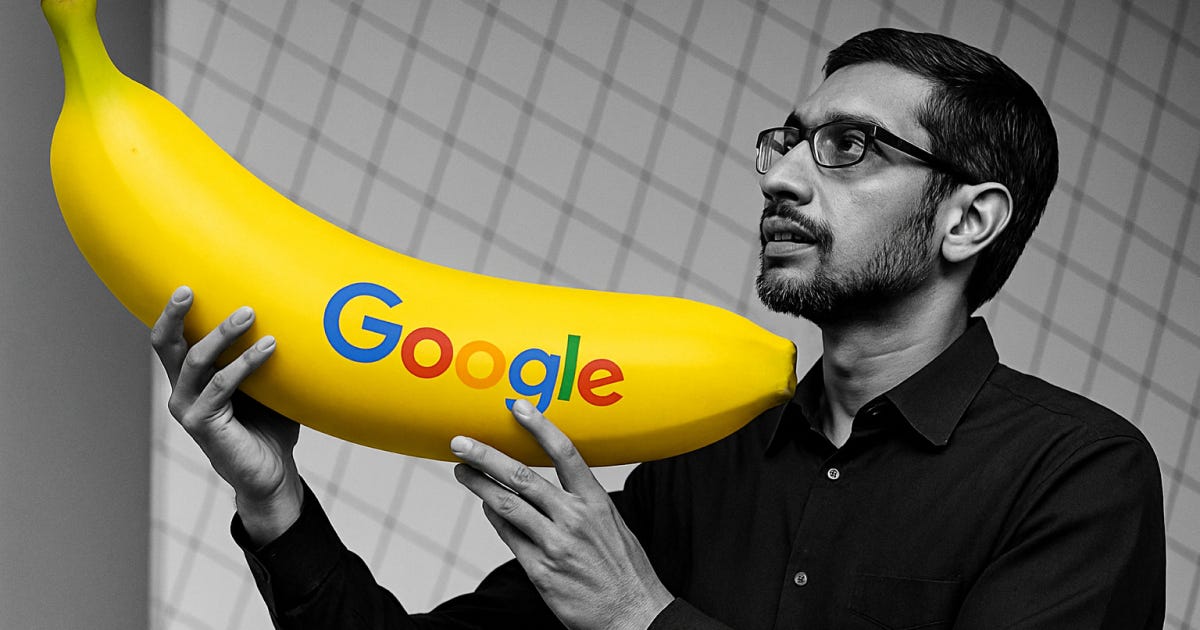
Earlier this month, I needed a thumbnail for The Signal, showing Sundar Pichai holding a banana. Simple enough. I opened Gemini and asked Nano Banana Pro—their state-of-the-art image generator—to create it.
My prompt was as follows: “Sundar Pichai holding a banana”. I was swiftly met with the following response from Gemini, “There are a lot of people I can help with, but I can’t depict some public figures. Do you have anyone else in mind?”
I was frustrated, but thought I could find a workaround. So, I downloaded an image of Sundar Pichai from Google, uploaded it to Gemini and asked Nano Banana Pro again, “make this man hold a giant banana with the Google logo on it”.
Once more, I did not receive the output I intended: “There are a lot of people I can help with, but I can’t edit some public figures. Do you have anyone else in mind?”
The irony struck with what I did next. I opened ChatGPT, uploaded the same image, typed the same prompt. And voila. I was met with Sundar, holding a picture of a giant banana with the Google logo.
Having to default to ChatGPT to get what I wanted, even though Nano Banana is state-of-the-art (SOTA) in image generation benchmarks, made me laugh.
Sure, Nano Banana Pro might give me a terrific infographic with superior text fidelity, but when I want to manipulate images (especially containing a public figure), I get a restricted response.
This also bleeds across to Gemini voice mode, too. I was recently asking it about a topical cream I got from a doctor on how best to apply it—Gemini refused to give help and reverted to “seek medical advice from a doctor”, whereas ChatGPT actually gave me useful instructions.
I feel there is an element of overregulation and restriction with Gemini right now. Google is building technically superior models, only to kneecap them with excessive guardrails. They’re so afraid of PR disasters that they’ve made their products less useful than competitors with weaker technology.
I find myself defaulting to ChatGPT for the exact reasons I outlined above. I’m interested to see how this continues to develop as real utility is derived not from maxxing benchmark scores nor safety theatre, but from simply letting people get work done.
Quote to Share
Paul Buchheit on AI’s threat to startups:
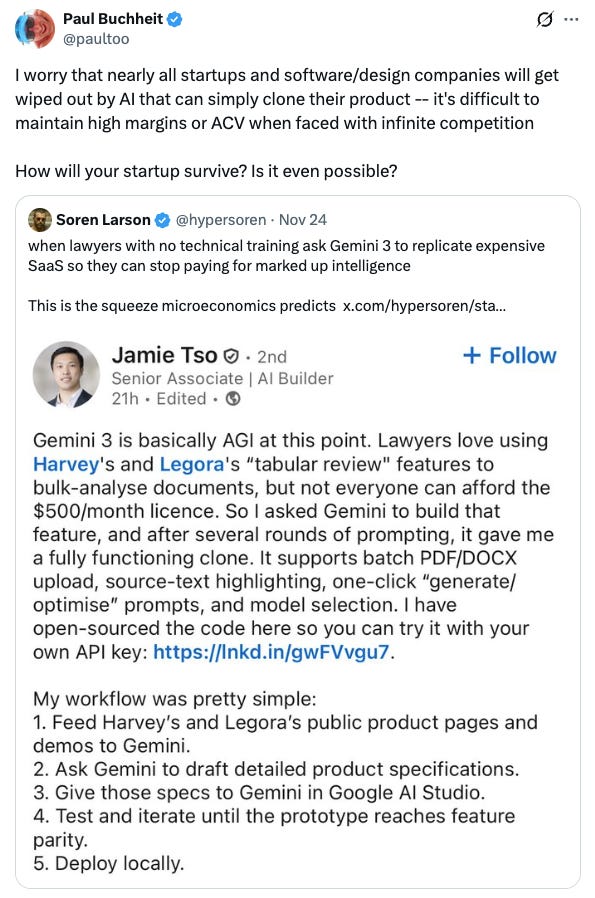
Buchheit’s concern stems from a specific example: lawyers using Gemini to replicate expensive legal SaaS products like Harvey and Legora’s document analysis tools. One AI builder demonstrated how Gemini can clone these $500/month features after “several rounds of prompting,” complete with batch processing, highlighting, and model selection.
The core economics are straightforward. If AI can reproduce your product’s functionality on demand, the value of your app layer approaches zero. This mirrors what happened in China’s SaaS market, where cheap technical talent enabled companies to build internal tools rather than subscribe to external products. Now AI serves as infinitely scalable, near-free talent.
But is this truly “infinite competition” or just the compression of the app layer? The legal tools being replicated still required someone to identify the problem, understand the workflow, and specify the solution. The AI didn’t spontaneously create better legal software; rather, it cloned existing products when explicitly directed.
It highlights an important question for startups today: can you build defensibility beyond the app layer? This includes proprietary data, embedded workflows, trust relationships, or genuine insight into problems customers don’t yet know they have.
If your entire moat is UI and basic functionality, you were always vulnerable to competition. AI just accelerates that timeline from years to weeks.
Source: Paul Buchheit on X
Question to Ponder
“A new UN report warns AI could trigger ‘the next great divergence’ - with advanced economies profiting while developing nations fall further behind. Can we really build a technology this powerful without making global inequality worse?”
Yes, AI could absolutely make global inequality worse.
While Singapore and South Korea invest heavily in AI infrastructure, many developing nations struggle with basic digital access. Women in South Asia are up to 40% less likely to own a smartphone than men, and jobs held by women face nearly twice the automation exposure.
The UN calls this the “next great divergence“—a reversal of decades where lower-income countries gradually closed gaps with richer nations through technology and trade. But this outcome isn’t inevitable.
Bangkok’s Traffy Fondue platform has processed 600,000 citizen reports, making city services more responsive. Singapore cut new parent paperwork from two hours to 15 minutes. Beijing uses digital twins for urban planning and flood management.
It’s clear AI can work for everyone, but the “central fault line,” according to UNDP’s Chief Economist, is capability. Countries that invest in skills, computing power, and strong governance will benefit. Those who don’t will fall further behind.
Right now, we’re at a fork in the road. The infrastructure, skills, and governance choices made today will determine whether AI lifts all countries or leaves most behind.
Got a question about AI?
Reply to this email and I’ll pick one to answer next week 👍
💡 If you enjoyed this issue, share it with a friend.
See you next week,
Alex Banks
Again, thank you insightful excellent up-to-date timing most appreciated🩷🍀🇺🇸👏
Great issue this week. I especially enjoyed the image-generation request with Sundar Pichai and the clever workaround. I’ve run into the same constraints with Gemini. ChatGPT tends to be a little more permissive and far more usable in day-to-day workflows. Gemini may be more powerful in certain areas, but ChatGPT often ends up being the tool I actually reach for.
I also loved your point about GPTs becoming the equivalent of disk drives, racing toward the bottom on price until no one really wins. That analogy is spot on. If there is an AI bubble brewing, I suspect its story starts and ends with OpenAI.