


In last week’s issue of The Signal, I answered the following question that was posed by Emad Mostaque, founder of Intelligent Internet.


He’d noticed that open-source AI has gotten seriously good, and asked what the bull case is for the frontier labs once open models are competent enough.
My answer on Sunday was “brand”; however, a reader pushed back, so I’ve been thinking about it since, and I think we were both half right. For now though, let’s start with how much it all costs.
If the price is right
Emad’s estimate is that DeepSeek V4.1 Flash, the Chinese lab’s newest model, released on 10 September under an MIT licence, cost around $10M to train. That’s 100x less than GPT-6 Astra, and he puts the running cost at 100x less too, whilst scoring about the same on everyday benchmarks.
DeepSeek charges $0.22 per million input tokens and $0.66 per million output tokens. OpenAI charges $10 and $50 for Astra. Call it 45-75x cheaper, depending on which way the tokens flow.
From a developer’s perspective, this matters enormously. Guillermo Rauch, who runs Vercel, posted that open models hit 78% of token volume on the Vercel AI Gateway on 19 September, against 22% for closed.


Spend, on the other hand, usually tells a bit of a different story, as open models usually handle most of the tokens because they’re cheap to run, meaning the money still goes mostly to the closed labs.
That split, most of the volume one way and most of the money the other, is the divergence we’re witnessing, but we need to dig a little deeper if we’re to answer what actually happens when the model underneath is nearly free.
The child models
OpenAI’s CFO Sarah Friar told Jim Cramer on 15 September that the frontier model is what trains the cheap ones. Sol trained Luna, OpenAI cut Luna’s price by 80%, and demand went up tenfold. She claims Luna is now cheaper than a Chinese model like GLM served on Cloudflare.
Therefore, the reason a $10M model can match a $1B model is that it learnt from the $1B model’s outputs, whether that’s OpenAI distilling its own or a Chinese lab distilling someone else’s. Everyone trains on everyone’s data. The frontier trains on the web; the small models train on the frontier. So the cheap model needs the expensive one to exist, which turns out to be a bull case for the labs as long as they’re the ones the child models are copying from, although not much of a bull case for their consumer subscriptions.
Brand is the moat
The real bull case for the labs is brand and reputation.
People in the West trust a model from Anthropic or OpenAI far more than one from China, because that’s how it’s been for decades with every other product line, and this one just happens to sit on the intelligence layer.
US models can even be behind Chinese models on benchmarks, but many US consumers will still use US models because they trust and have “heard of” the parent provider before. “Capability matters, but distribution matters more” was my answer on Sunday, but one of my readers came back with the following objection:
“Brand trust is stickier for enterprises (compliance, accountability, someone to call) than for consumers, who don’t have real switching costs. If open models keep closing the price gap this fast, that consumer loyalty might be more fragile than it looks.”
Which I think splits the question three ways.
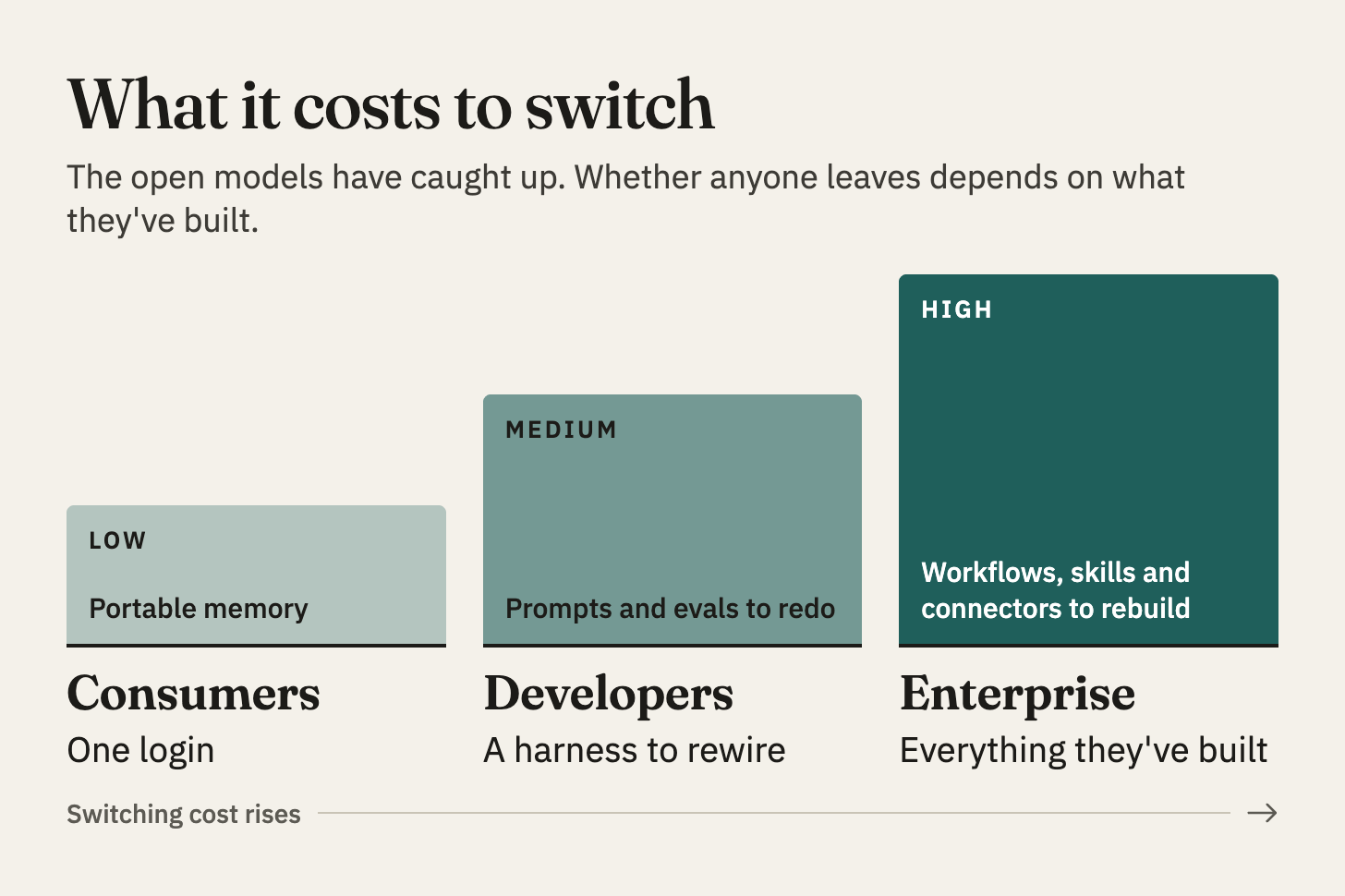
That’s what the rest of this issue is about, and ultimately, how it affects you as the consumer of these tools.
