


Hey friends 👋
Welcome back to the Signal Pro.
Predictions about AI and work now stretch from one pole to the other, from warnings that almost every job is about to disappear to reassurances that very little will really change. Anthropic’s CEO managed to occupy both ends himself inside a single year. He told Axios in 2025 that AI could remove half of all entry-level white-collar jobs and push unemployment as high as 20% within five years, and by 2026, he had softened that line considerably, leaning instead on the idea that automating most of a task mainly frees people up to do more of the rest. For anyone trying to make an actual decision about their own career, a range that wide is close to useless.
Rather than add another forecast to that pile, this issue works from what the data already shows and from the one question you can actually answer about your own role today. The worry I hear most often, in some version or another, came from a reader in a recent Sunday newsletter: “I feel like I’m falling behind with AI, and I don’t know if my job is safe.” That worry is reasonable, and there is a clear way to turn it into something you can act on.
Today I’ll show you:
What the data actually says about AI and jobs, separated from the noise
The distinction that defines the roles under pressure from those holding up
Where the value in knowledge work is moving, and what that means for you
The exact 20-minute audit I run on my own role to find where I’m exposed
The prompts and 90-day plan to reposition before it matters
What the data actually says
The broadest and most credible map we have is the World Economic Forum’s Future of Jobs Report 2025, built from more than 1,000 employers covering 14 million workers. Its central projection points to large-scale churn, with as many roles created as lost and then some. By 2030, it expects 170 million new roles to appear and 92 million to be displaced, a net gain of 78 million, with around 22% of all jobs changing in some way. Roughly 39% of the skills a given job requires are expected to shift over the same period, down from 44% two years earlier. The fastest-growing roles cluster in technology, including AI and machine learning specialists, big data and fintech roles, software developers and security specialists, while the steepest declines fall in clerical and administrative work.
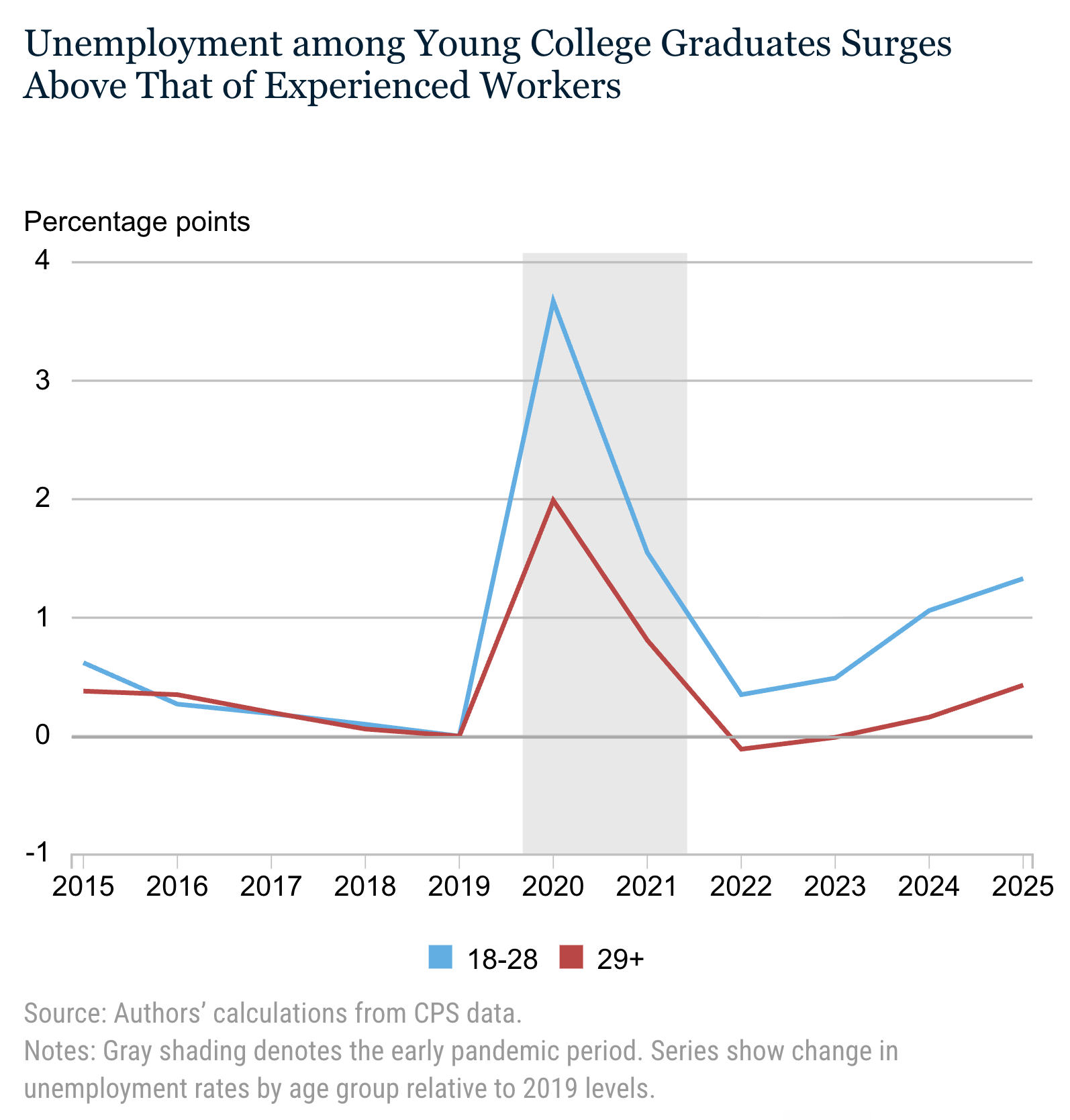
The more uncomfortable signal shows up among people just entering the workforce. Researchers at the Stanford Digital Economy Lab tracked millions of payroll records and found that workers aged 22 to 25 in the occupations most exposed to AI have seen a 13% relative decline in employment since late 2022, with young software developers down close to 20% from their peak, even as their more experienced colleagues held steady.
More recently, graduates are sitting at around 5.6% unemployment against roughly 4.2% for the workforce as a whole, and the largest technology firms are hiring around half as many new graduates as they did before the pandemic.
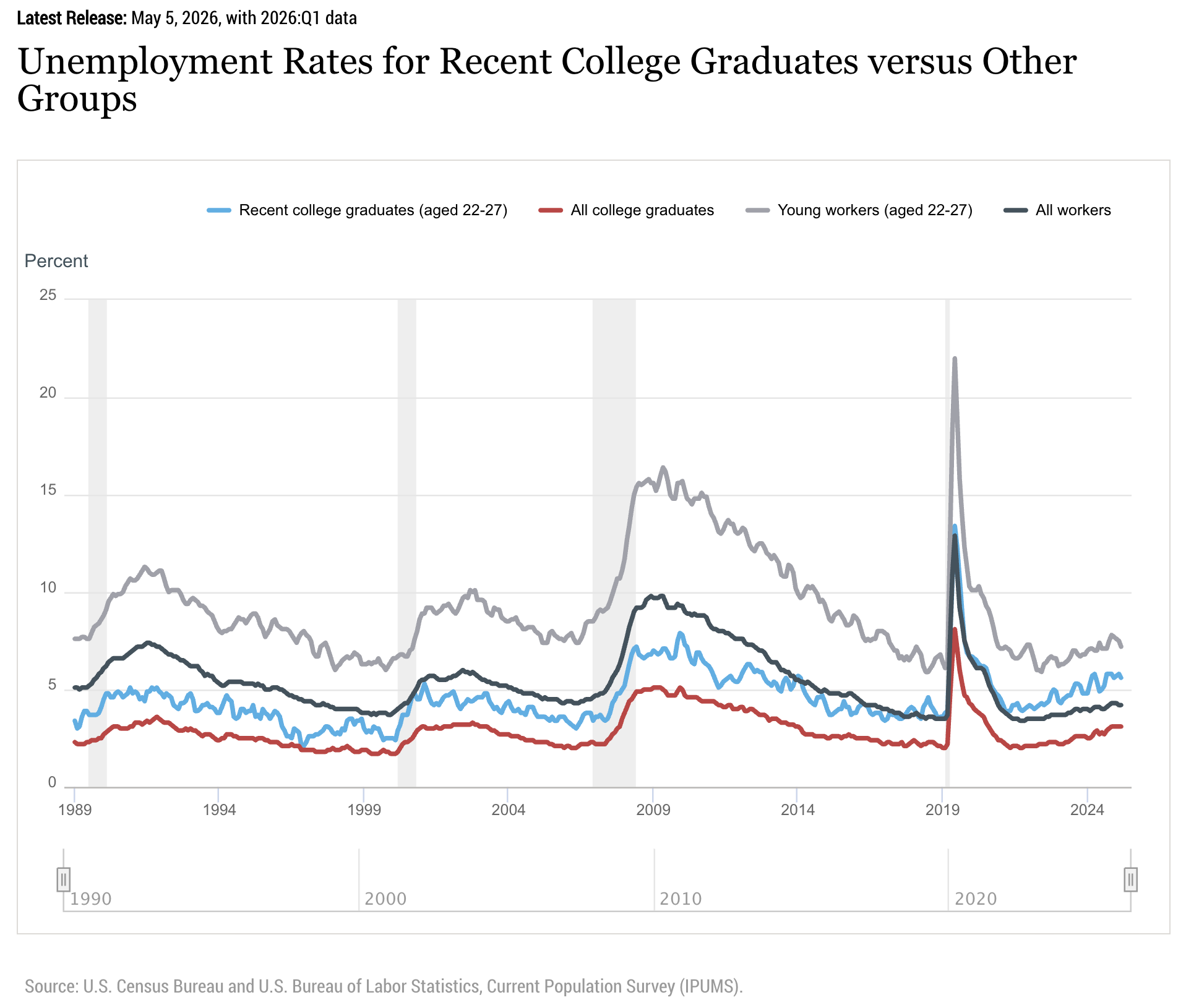
The New York Fed also published an analysis attributing roughly two-thirds of the rise in young-graduate unemployment to remote work, on the logic that firms are wary of hiring inexperienced people into roles where mentorship is hard to provide.
On the recovery side of the story, graduate hiring is projected to rise modestly this year, and internship postings are up sharply. But it’s fair to acknowledge that early-career knowledge work is under real, measurable strain, with AI as one driver among several and the damage concentrated in particular kinds of work.
Automate or augment
Double-clicking into the work by Stanford Digital Economy Lab, we can see clearly where the declines are concentrated. Employment fell in the roles where AI takes over the task itself, and held steady or grew in the roles where AI speeds up work a person already does and still owns.
A junior analyst whose day mostly consists of turning a brief into a first-draft model or memo is doing work that current tools can largely produce on their own. A client lead who uses those same tools to prepare faster, but whose real value is the judgment and the relationship in the room, is doing work that those tools make sharper. The first role sits in what I’d call the automate zone, and the second in the augment zone. Whether your own position holds over the next few years depends far less on your industry and far more on where your daily tasks fall along that line.
This is important in two parts. First, you need to hold up the reflective lens. Then, you need to thoughtfully apply what you see to your own situation. In the rest of this issue, I’ll show you where the value in knowledge work is moving, then walk through the exact audit I run on my own role each quarter, including the prompts, so you can map your own position and act on it this week.