

SpaceX's Cursor Call, OpenAI's Codex Clone, and Midjourney's Medical Moonshot

Hey friends 👋 Happy Sunday.
Here’s your weekly dose of AI and insight.
Every Wednesday, Signal Pro members get a step-by-step AI workflow they can apply immediately. No fluff, just practical guides to upskill you and your team. If you’re only reading the Sunday issue, you’re getting half the picture. Upgrade to Pro today.
AI Highlights
My top-3 picks of AI news this week.

SpaceX
1. SpaceX’s Cursor Call
SpaceX agreed to buy AI coding tool Cursor for $60 billion, all stock, days after its $75 billion IPO, the largest in history.
All-stock deal: SpaceX is paying entirely in its own stock, roughly double Cursor's $29.3 billion valuation from November, with completion expected in Q3. Cursor gave SpaceX the right to buy it this year for $60 billion, or to take $10 billion for the partnership, terms agreed back in April before SpaceX went public.
Top but pressured: Cursor is still the most-used vendor in Ramp's Code AI category as of May 2026, but the foundation labs now ship their own coding agents straight into the same buyers, and overall category adoption ticked down to 19.8%.
Tool turns model: Days after the deal, Cursor's CEO unveiled a 1.5 trillion parameter model trained on more than 100,000 GPUs, which plugs into xAI's Colossus supercomputer in Memphis.
Alex’s take: Grok never caught the leading models, and enterprises stayed away from it. Rather than spend years closing that gap, SpaceX bought the tool engineers already open every day. It helps that SpaceX can pay in its own richly valued stock, which makes a $60 billion cheque cost far less in dilution than what the headline might suggest. The part I keep coming back to is what Cursor does next. Right now, it sits on xAI's Colossus compute and has already shown its own 1.5 trillion parameter model, so the tool and the model are folding into one company. It’s clear that now, any developer tool that’s still shipping on someone else's model and infrastructure is essentially renting its future, and Cursor learned how fragile that is when Composer 2 ran on Moonshot's Kimi and landed flat. Owning the model is the whole game now, and SpaceX has the engineers, the compute, and the orbital data centre roadmap to play it for years.
OpenAI
2. OpenAI’s Codex Clone
OpenAI added Record & Replay to its Codex app, a macOS feature that watches you complete a task once and turns that demonstration into a reusable skill. It also rebuilt ChatGPT’s scheduled tasks, so recurring jobs now run to a schedule rather than waiting on a prompt.
Show it once: It suits stable, repetitive jobs like filing an expense or pulling a weekly report, needs Computer Use enabled to watch and act on your Mac, then lets you replay the saved skill with fresh inputs.
An editable skill: Codex inspects the recording and drafts a skill that lays out when to use it, what inputs it needs, the steps to follow and how to verify the result, all of which you can read and edit.
ChatGPT joins in: ChatGPT’s rebuilt scheduled tasks add a dedicated page for recurring and monitoring jobs, where monitoring tasks watch the web or your connected apps and notify you only when something worth reporting changes, now live across the paid tiers on web and mobile.
Alex’s take: Raw agentic computer use has been a “fun toy” to experiment with so far, but ultimately, I’d yet to trust it for real workflows. Record & Replay takes that to the next level and creates a reusable skill you can open, read, and correct, rather than a black box of clicks you have to blindly trust. Especially when you pair this with ChatGPT’s upgraded scheduled tasks, where monitoring jobs now ping you only when something actually changes, and you end up with an agent that learns your routine once, then runs it on a timer at your convenience. Perfect for white-collar admin work like filing expenses, time-off requests and creating a weekly report that nobody enjoys pulling together. It’s the unrepeatable work that’ll be harder to disrupt here.
Midjourney
3. Midjourney’s Medical Moonshot
Midjourney, the AI image company, launched a medical division and unveiled the Midjourney Scanner, a full-body ultrasound that images your entire body in roughly 60 seconds.
How it works: The scanner lowers you into a shallow pool ringed with hundreds of thousands of ultrasonic sensors, fires soundwaves through the body from every angle, and reconstructs the data into 3D images of muscle, fat, bone, and organs, a method it calls Ultrasonic CT. No radiation, no magnets, and around 800 terabytes of data per scan.
Built on Butterfly: The hardware runs on 40 Butterfly Network Ultrasound-on-Chip modules per system, licensed under a co-development deal the two companies signed in November 2025.
The scale play: Funded entirely by image-generation subscriptions with no outside investors, Midjourney is targeting 50,000 scanners worldwide and a billion scans a month by 2031, starting with a San Francisco spa at the end of 2027.
Alex’s take: Radiologists have spent years warning that whole-body screening mostly surfaces false positives and harmless oddities, each one pulling patients into follow-up biopsies that carry real risk, so a cheaper and faster scanner threatens to multiply that harm instead of actually preventing it. The counterargument is that this reflects how poorly doctors weigh information rather than any flaw in the scanning itself, and that an AI layer reading the images could tip the maths back in screening's favour. Critically, that layer doesn't exist yet, and it's precisely why the only cleared use on day one is the low-stakes one of understanding body composition. Even if the device works perfectly and clears regulators, the unresolved question is whether mass-screening millions of healthy, asymptomatic people is good medicine at all.
Content I Enjoyed
Robots that improve while the team sleeps
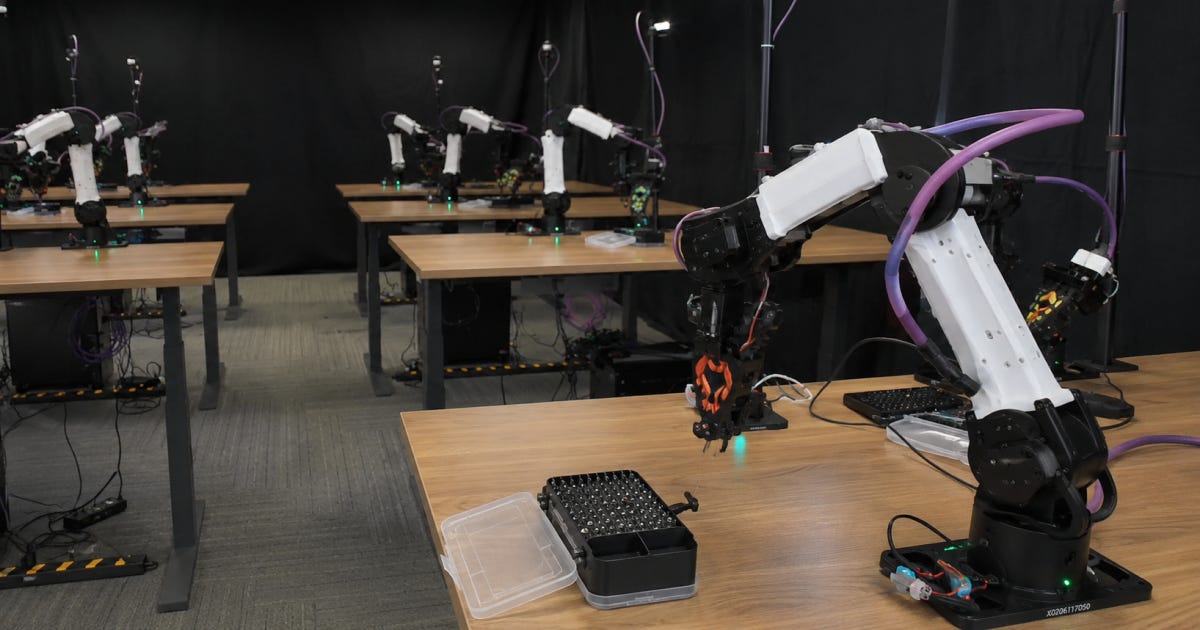
Jim Fan, NVIDIA’s Director of Robotics, announced ENPIRE this week as bringing “AutoResearch in the physical world for the first time”, his Generalist Embodied Agent Research (GEAR) lab improving itself overnight while the team slept. Eight Codex agents (OpenAI’s coding agents) were handed a fleet of real robots, a stack of GPUs and a large token budget, with a single goal: solve the task as fast as possible, keep the robots busy and stay safe. The robots taught themselves to cut a zip tie, slot pins into a box and seat a graphics card into a motherboard, reaching a 99% success rate with up to eight attempts per step. The team were able to read the results by the next morning.
The one thing the agents were never allowed to touch was the definition of success. An agent that can edit its own reward will rewrite it to declare victory, so the team fixed the measure before the run. This involved a separate vision system that watches the cameras, decides whether each task actually worked, and stays frozen where no agent can reach it.
The easy part, it turns out, is the research itself. The agents will read papers, propose methods, debug and retry on the hardware all night, but they cannot be trusted to mark their own work, and so the part that stays stubbornly human is defining success in a way the system cannot quietly optimise around. The lab ran unattended because someone first built a referee the agents could not bribe.
Idea I Learned
The Learning Loop Is the Real AI Advantage
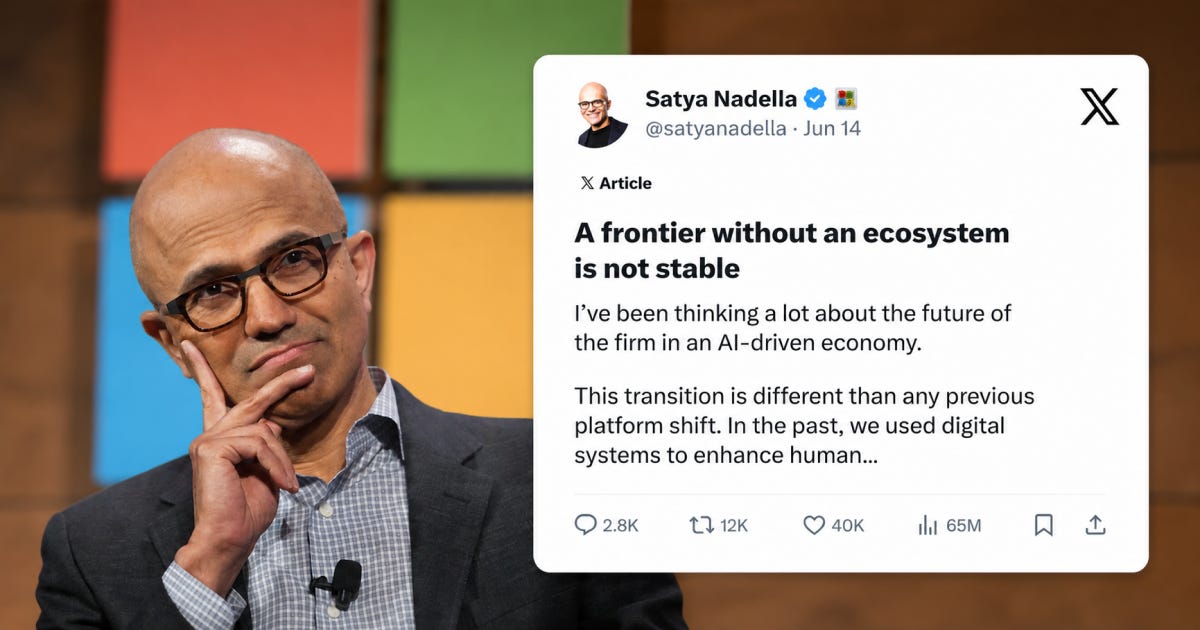
You can offload a task, or even a job, but you can never offload your learning. That’s the line Satya Nadella built a whole article on X around this week, about the future of the firm.
His case rests on every company needing two kinds of capital. Human capital is the judgement and pattern recognition of its people; token capital is the AI capability a firm builds and owns. The human side grows more valuable as the AI side grows, because someone still has to set the goals and join the dots, and without that the compute just spins.
The real prize, he argues, sits a level above the model itself—the learning loop you build on top of whatever model you happen to use, turning your workflows and accumulated judgement into a system that improves every time it’s used. Swap the model underneath for a newer one and you keep the company-veteran expertise trained into it, and that loop becomes IP that no rival can copy.
His warning is that no company should want a world where value flows to a few models that absorb everything they touch. He likens it to the first wave of globalisation, when whole industrial economies were hollowed out, and the bill is still landing.
The point I’m taking from it is actually quite a simple one. Anyone can rent the same model, so the only edge that lasts is the learning you stack on top of it. That’s the bit a competitor can’t buy, and the part most companies aren’t building yet.
Quote to Share
David Sacks, the former White House AI czar, on the Anthropic Mythos standoff:


David Sacks is the venture capitalist (PayPal, Craft Ventures, the All-In podcast) who served as Trump’s first AI and crypto czar and now co-chairs the President’s Council of Advisors on Science and Technology. For months he has been the administration’s loudest Anthropic sceptic, and his recent post answers a run of articles claiming he waved away the cyber risk of Mythos, the company’s most capable model.
Last week the administration ordered Anthropic to disable Mythos 5 and the safety-restricted Fable 5 worldwide, after Amazon researchers reportedly “bypassed” some of Fable’s guardrails. Anthropic complied while disputing the order, arguing the jailbreak was narrow and that the same trick elicits comparable behaviour from other public models, OpenAI’s GPT-5.5 included.
Sacks blames the whole mess on Anthropic's hostility towards the White House. So why does the ban hit Anthropic and nobody else? He says the AI Security Institute found OpenAI's GPT-5.5-Cyber performing much like Mythos, yet GPT-5.5 stays on sale and Anthropic's models are pulled. The same models could help defenders find and fix vulnerabilities, which is why dozens of cybersecurity experts have signed a letter calling the ban self-defeating.
Source: David Sacks on X
Question to Ponder
“Why do LLMs give different answers even if I ask the same question?”
There’s an excellent deep-dive by Horace He in collaboration with others at Thinking Machines (Mira Murati, the ex-CTO at OpenAI’s AI company) that perfectly explains this phenomenon.
This inconsistency isn’t actually a bug, but is by design. However, there’s more to the story than most people realise.
When you ask an LLM the same question multiple times, you get different answers because of “sampling.” Instead of just picking one answer, the model calculates probabilities for thousands of possible next words and randomly selects based on those probabilities. Think of it like a weighted dice roll for every single word.
Even when you set the “temperature” to zero—which should make the model always pick the highest probability word—you still get variations. This surprised many people, including researchers.
The real culprit behind this isn’t actually the sampling process itself, but something called “batch invariance.”
When you make a request to an LLM API such as ChatGPT, your question gets processed alongside other users’ requests in batches. Depending on how many other people are using the system at that exact moment, the internal math calculations can produce slightly different results due to floating-point arithmetic limitations. It’s a bit like getting a different restaurant experience because you happened to arrive when they were busy versus quiet.
Mira Murati’s team at Thinking Machines shows they can eliminate this inconsistency entirely. Their solution involves redesigning the GPU operations to be “batch-invariant” meaning your result doesn’t depend on server load filled with other people’s requests.
But there’s a key distinction here: solving consistency doesn’t solve correctness.
With their approach, if you were to ask an identical question ten times, you’d get the same wrong answer ten times instead of ten different answers, where one might be right.
For most casual use, the current inconsistency is actually helpful for it gives you multiple creative perspectives. But for business applications requiring reproducibility (such as medical and legal domains), consistent answers will be game-changing.
Already a subscriber? Get your whole team on board. Signal Pro group subscriptions give everyone access to weekly AI workflows and tutorials, practical upskilling that pays for itself. It’s the kind of thing L&D budgets were made for. Share this with your manager today.
💡 If you enjoyed this issue, share it with a friend.
See you next week,
Alex BanksP.S. AI just took our jobs.